Same look on web, macOS and iOS
One shared core computes the CSS cascade, web layout, CoreText text and painting. AppKit and UIKit only host the views.
Octapus runs a plain Octane .tsrx app on Hermes with real UIKit and AppKit views. A first-screen snapshot baked at build time is on screen in under 3 ms, before any JavaScript runs. Your agent writes the app; one build command tells it what broke.
oct build --target web,ios,mac --bake
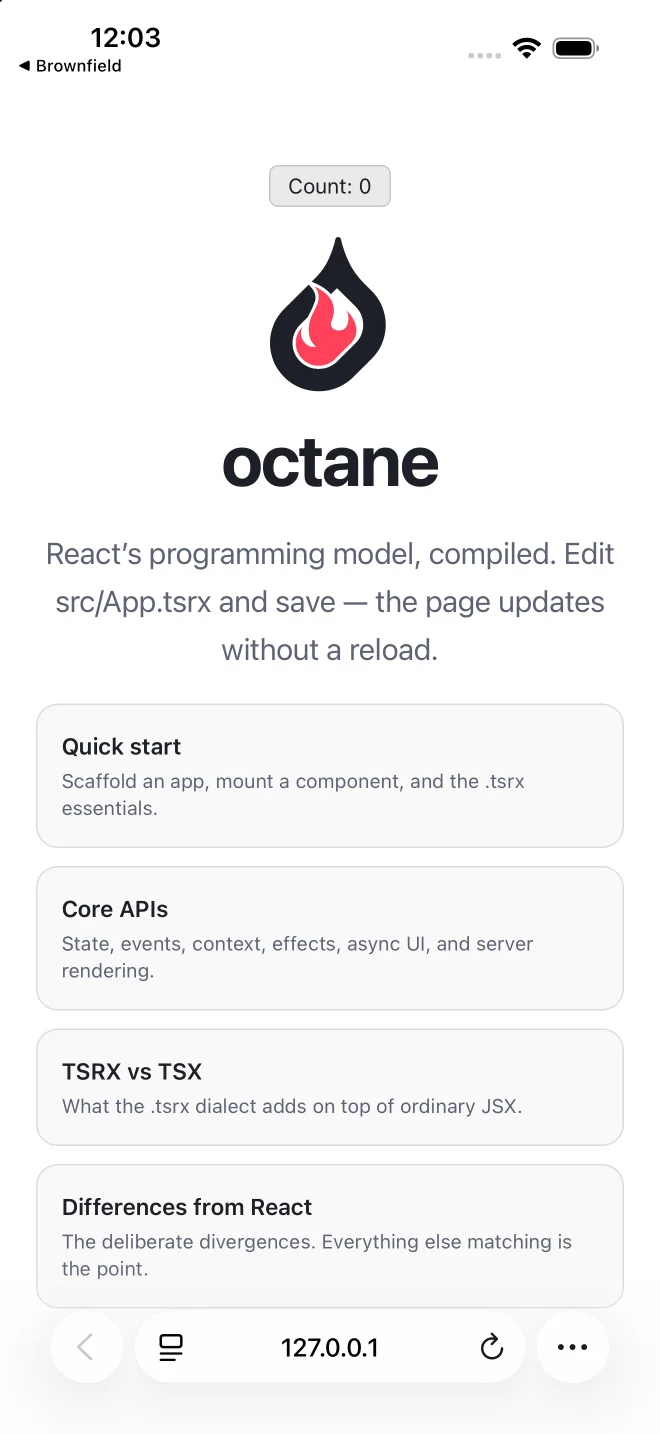
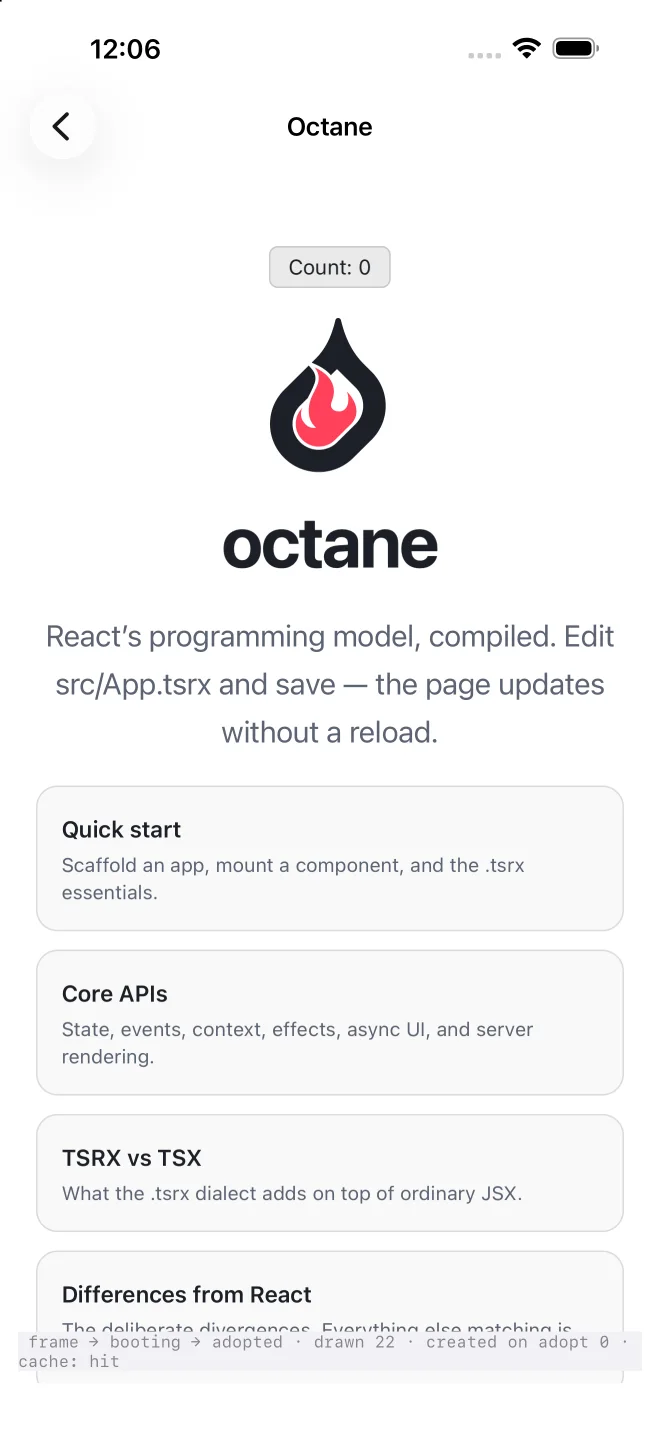
iOS Simulator captures of examples/app. The native capture keeps its launch overlay: created on adopt 0 · cache: hit.
Launch, replayed
Two real launches of the same app, slowed down 20×. Without a snapshot the screen stays blank until Hermes has built the whole tree. With one, the frame is up in under 3 ms and Hermes adopts the views that are already on screen.
Blank until Hermes has run the app and created every view.
Not launched yet
The snapshot (.ofrm) is drawn before any JS. Hermes then adopts those views.
Not launched yet
Timings from the example app's LaunchMetrics log in the iOS brownfield host (iOS Simulator). The snapshot launch is a frame-cache hit: read 0.09 ms, draw 2.8 ms, adopt 4.8 ms.
Live demo
The frame below is examples/app built with oct build --target web: a small gallery of demos. Its Starter tab is the official Octane starter, the screen in the native captures above.
Loading the example app…
import { useState } from 'octane';

export function Counter() @{
  const [count, setCount] = useState(0);

  <button onClick={() => setCount(count + 1)}>
    {'Count: ' + count}
  </button>
}Pipeline
Web ships as DOM. Native ships as Hermes bytecode plus a first-screen snapshot. At launch the snapshot shows first and Hermes hydrates it.
Native views drawn at O(1) per row. No JS.
Adoption mode takes over the screen. Zero new views.
Features
One shared core computes the CSS cascade, web layout, CoreText text and painting. AppKit and UIKit only host the views.
A first-screen snapshot (.ofrm) baked at build time is drawn in one forward pass, O(1) per row. Hermes comes after.
Drop OctapusView into an existing UIKit or SwiftUI app. The public modules expose C headers only, so C++ interop stays off.
oct build builds web, ios, android, mac and windows with Vite + Octane. Branch per target with import.meta.env.OCT_TARGET.
Usage
$ pnpm install && pnpm hermes
$ pnpm app
# = oct build --target web,ios,mac --bake

# or run it directly
$ oct build --target web,ios,mac --bake \
--viewport 640x480import OctapusAppKit
import SwiftUI
struct ContentView: View {
var body: some View {
// dist/mac: app.hbc + app.ofrm + app.css
OctapusView(bundle: OctapusBundle(directory: url))
}
}Measured on macOS
Measured on macOS with the official Octane starter app (examples/app). Time to interactive is from a debug build in the dev tool.